
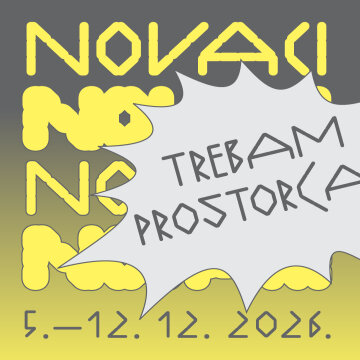
NOVAci: I Need Some Space
The exhibition "I Need Some Space" curated by Marta Agičić and Tina Petković, is the result of this year’s edition of the project NOVAci, realized through a collaboration between WHW and Pogon.
Although the phrase I Need Some Space is generally associated with a need for distance – from a situation, a relationship, or a person – it can also express a desire for a space to call our own. A space where we can pause and find time for ourselves, where we can work and act, create new contexts and new relationships. The space we seek is not necessarily just physical, nor can it be regarded as a neutral backdrop. Rather, space is shaped by the ways in which we use, organise, share, and appropriate it, but also by the work required to preserve and maintain it.
The lack of space has been a persistent issue on the local cultural scene since its emergence during the post-socialist transition, and it continues to affect those involved in the scene to varying degrees. When discussing workspaces and exhibition spaces in culture, the key questions extend beyond availability to include how these spaces are managed and maintained, who has access to them, and under what conditions. Although the issue of space also concerns us on a personal level, recent developments on Zagreb’s art and cultural scene have provided a strong impetus to explore it further. Pogon – Zagreb Centre for Independent Culture and Youth is consistently overbooked; the Miroslav Kraljević Gallery has had to vacate its premises in the INA building on Šubićeva Street; and the future use of the former slaughterhouse complex (Klaonica) on Heinzelova Street remains a complex issue. The curatorial collective What, How & for Whom (WHW) has lost the space that housed Gallery Nova on Teslina Street, while their new space on Draškovićeva Street is still not operational. These developments, together with the general shortage of physical spaces capable of meeting the needs of the cultural scene as a whole, demonstrate just how closely the possibilities for cultural production and the availability of space are tied to specific social and political conditions. Yet displacement, relocation, closures, changes of use, and uncertainty over space go beyond unresolved issues of cultural policy – they directly affect the continuity of work, opportunities to come together, and building relationships that sustain the cultural scene.
The exhibition I Need Some Space thus explores space on several levels: as both a concrete and an abstract concept, and as a physical and a virtual place. It addresses the chronic shortage of space, issues of labour rights and material working conditions in the cultural sector, and the role of space in shaping symbolic value, capital, and status, as well as personal experiences. The exhibition brings together five artists at different stages of their personal and professional journeys. While some are already established artists who must work to maintain their position on the art scene, others are only beginning to make a place for themselves or have yet to take their first steps, while still others come from a neighbouring cultural context shaped by its own particular circumstances. Through a dialogue between spatial and sound installations in Pogon Jedinstvo’s small hall, the artists offer different perspectives on and experiences of working within the local art and cultural scene. Running through these perspectives is another important underlying theme – the understanding of art as labour.
In her installation Corner (2026), produced for this exhibition, Sanda Črnelč explores the relationship between the interior and the exterior, examining physical, emotional, and creative spaces, as well as those that emerge between the artist, their work, and the viewer. For Črnelč, space is not merely a physical category but also a state, a boundary, and a possibility. The central motif is the corner, which serves as both a spatial and symbolic focal point; it is simultaneously a place of shelter and exposure, a boundary and a threshold, a source of safety and discomfort. Neither the position of the viewer nor the space in which the work is exhibited are neutral; both shape how the work is perceived and how its meaning is redefined through their interaction. Both the space and the work take shape precisely in the transition between what is hidden and what is exposed, what is imagined and what is realised.
Kara Marušič also explores the boundary between public and intimate space in her installation BedSat I. (2026), the latest iteration of her project examining the conditions of artistic labour. As an artist from neighbouring Slovenia, Marušič brings an additional perspective on cultural and artistic production to the exhibition, informed by mounting pressure on the independent cultural sector through the suspension of projects initiated by the previous government, as well as funding freezes and cuts, following the right’s rise to power in Slovenia’s parliamentary elections in March of this year. In a site-specific installation at Pogon Jedinstvo, Marušič takes her own bed – a place of rest that also serves as her workspace – out of its everyday setting and launches it as a satellite, referencing the fictional story The Jupiter Residency from the book Poor Artists (The White Pube). Rather than treating the bed as a refuge from the precarious conditions of the cultural sector, Marušič explores working from bed as a compromise between passivity or rest and the need to keep working. As artists are forced to navigate the unstable framework of “project temporality” (Artist at Work: Proximity of Art and Capitalism, Bojana Kunst, 2015), their work is always oriented towards its completion at some point in the future. Marušič’s work thus exists in time borrowed from the present, just as it occupies space borrowed from her private sphere.
In Saving Myself for What's to Come (2026), Kristijan Popović reflects on the boundary between work and non-work and the possibility of understanding time and space that are not directly devoted to production as a realm of personal agency. The work’s starting point is the artist’s planned move to Denmark to take up a job as a night watchman – a typical scenario of economic migration from Europe’s periphery to the wealthier West in search of a better standard of living. Popović raises questions about how an artist adapts to a new context and environment and how to navigate unfamiliar systems of guarding, surveillance, and the supposedly more “serious” institutional culture of the West. In this scenario, the artist and the watchman are not opposites but two versions of the same role: someone who guards something while also inevitably making use of what they guard. Drawing on Mladen Stilinović’s In Praise of Laziness (1993), which contrasts the laziness of artists from the East with the relentless productivity of their Western counterparts, Popović, as a future artist in the West, must also become the guardian of his own laziness to preserve what makes him an artist.
Drawing on research into public space, specifically the transformation of the former industrial site of Pogon Jedinstvo on the Sava embankment into a space for cultural production, Claudia Bošković’s new sound installation Score for Unity (2026) examines space as an evolving structure shaped by different forms of production, labour, and use. The workspace itself becomes an installation, while the exposed speaker membranes, transmitting the mechanical sounds of the open production process, bring the sounds of production back into the space as traces of the activities that sustain and continually reconstitute it. In doing so, Bošković draws attention to the technical and often invisible labour that precedes the public presentation of artistic work.
Building on her research into Kurziv’s Alphabet of Independent Culture archive and a survey conducted in 2025 among students of the Academy of Fine Arts (ALU), the Academy of Dramatic Art (ADU), and the Faculty of Humanities and Social Sciences (FFZG) to explore how strongly they identify with the artists, initiatives, and spaces featured in the archive, Katerina Duda presents the findings of nearly two years of research in Unobservable (2026), a work created for this exhibition. Through an interactive spatial installation in the stairwell of Pogon Jedinstvo, Duda examines how knowledge of the independent cultural scene is passed down between generations. She wonders if hers is among the last generations for whom this material remains familiar and part of their lived experience, and whether this archive holds any significance for those just beginning to learn about art today.
Whether it is a matter of finding a space of one’s own on the cultural scene, maintaining an existing space, reflecting on working conditions, or passing on knowledge about the history of cultural spaces, it is essential to continually question the practices and policies that enable or hinder their use. In this sense, the proposition I Need Some Space is not a response to feeling overwhelmed or a desire to withdraw, but a reminder that working in the art and cultural sector involves a constant collective struggle to claim the spaces to which we are entitled.
Marta Agičić and Tina Petković
The exhibition I need some space is the result of NOVAci, a project developed in collaboration between WHW and Pogon – the Zagreb Center for Independent Culture and Youth. The program is based on an open call and is being carried out for the sixth time this year. It is designed to provide early-career curators with the infrastructural, organizational, and mentoring support to realize their first solo curatorial projects. NOVAci functions as a support platform for developing knowledge in the field of contemporary art, with a focus on practical experience in curatorial practice – something that is largely absent from formal studies. As part of the project, curators Ana Kovačić and Lea Vene mentored two curators over several months: from developing the concept and meeting with artists to selecting works, designing the exhibition, and reporting on the project.
Katerina Duda’s work Unobservable (2026) was produced as part of the project Alphabet of Independent Culture, in co-production with Kurziv – Platform for Matters of Culture, Media and Society.
The program is supported by:
City of Zagreb – City Office for Culture and Civil Society
Ministry of Culture and Media of the Republic of Croatia
Kultura Nova Foundation


