Pogon Jedinstvo: From a Factory for Factories to a Hub for Culture
Tina Petković presents an overview of the Pogon Jedinstvo site of the Trnje city district along the river Sava and the transformations of the building itself, illustrated with a variety of photographic and cartographic materials.
The building at 34 Trnjanska struga – home to the House of Extreme Musical Theatre of DB Indoš, the club Močvara and Pogon Jedinstvo – and the entire district of Trnje have had a difficult journey from the very outset, but their permanent and occasional residents – citizens, artists, culture workers and audiences – still strive earnestly to reach for the stars. Since its beginnings as a shack-strewn village of serfs in the sixteenth century, Trnje developed into a suburban working-class settlement that urbanized only gradually, so this space of unrealized potential in the city is still waiting for its zoning tangles to be unraveled. Just as Trnje’s past and the future are marked by disarray and uncertainty, the history of the industrial building that was once the production facility of the Jedinstvo factory, and the Institute of Process Engineering before it, is likewise marked by ambiguity and obscurities due to the lack of archival and other types of sources.
Trnje – From a Prehistoric Settlement and Border Village to a Working-class District on the Edge of Zagreb
The process of settling the area of Trnje can be traced back to prehistoric times, and its continuous development through antiquity, the Middle Ages, and the modern era has transpired roughly within the same boundaries of the present-day city district: southwest from the intersection of today’s major streets Ulica grada Vukovara and Avenija Marina Držića, and parallel to the river Sava. The area known as Trnje, first mentioned in the Golden Bull of 1242 by King Béla IV, was a settlement of the city’s serfs until its dissolution in the middle of the nineteenth century, charted as part of the wider territory of Gradec in 1766 along with groves, numerous river distributaries and the entire agricultural area of Trnje. With the unification of previously independent settlements of Zagreb in 1850, Trnje was officially incorporated into the City of Zagreb, which is when its development as an urban fringe began, and its workshops for the production of military headgear and patent leather were a foreshadowing of imminent extensive industrialization. With the construction of railroads and the Main railway station in 1865, Trnje was physically severed from the city center, while its urbanization began with the First Plan for the Expansion and Embellishment of the City of Zagreb. The course of this fragmented urbanization process is simply one aspect of an unfortunate series of conceptual and only partially implemented regulatory public tenders and plans that extended well into the early twenty-first century, all which have left Trnje in a state of infrastructural disarray.
At the turn of the twentieth century, the number of factories in Trnje increased rapidly, including the likes of the steam mill Paromlin, the Gredelj Railway Vehicle Factory, the paper mill, the Vilim Reiner Textile Plant, the city gasworks etc, which subsequently resulted in a population increase. Trnje thus became a working-class settlement in which the space factories and other industrial facilities were dotted by artisan workshops, taverns and small grocery stores here and there, and the “typical” dwellings – haphazardly and illegally built shanties. Made out of construction waste, these small ground-floor and single-story houses with no electricity or running water did not adhere to zoning, architectural, municipal and residential standards of Lower Town Zagreb. Most of its tenants in the past century, in spite of all the hardships they endured, remember a simple and happy life in Trnje, full of socializing in the neighborhood orchards, playing hide-and-seek in the meadows and swimming in the distributaries of the Sava.

The post-World War II period was marked with even greater destitution, and since no zoning regulations were being enforced, illegal construction kept being tolerated in Trnje. However, the second half of the twentieth century saw the construction of many representative buildings, such as the Kockica (formerly the seat of the Central Committee of the League of Communists of Croatia, and currently a Ministry building), the Vjesnik skyscraper, the Vatroslav Lisinski Concert Hall, the Croatian Radiotelevision building and the National and University Library etc. Despite numerous (overly)ambitious development plans and certain impressive achievements, the urban development of the wider Trnje area is yet to come.

The Sava Riverbank as a Space for Everyday Life and Industry: Public Bathing in Trnje and the Institute of Process Engineering
The areas along the Sava, especially its northern bank in Trnje, have been vibrant since they were first settled, even more so than today. Before its course assumed the recognizable arc it has today, from Podsused to Jakuševac, the Sava was a well-indented river with a shifting riverbed and numerous distributaries, islands and sandbanks, and a very precarious area in terms of permanent settlement due to constant flooding. Even though its course started being regulated well before that, the construction of the river embankment in the 1920s proved to be slow and ineffective due to underinvestment, thus the flooding continued unabated. It all came to a head in the great flooding of 1964, which in turn prompted the construction of an efficient flood defense system for the greater Zagreb area. Despite all of this, the inhabitants of Trnje, and beyond, made daily use of the Sava: they watered and cooled their geese and cattle; the carters gathered gravel for sale; in winter, the children skated across frozen ponds created by the receding water level; and learned to swim in its inlets during the summer.

There were several public bathing sites along the Sava, the earliest being Huterrer’s Lido from 1865, situated at the far end of the street that was was then known as Trnjanska ulica, which is roughly where Pogon Jedinstvo stands today. Franjo Huterrer opened another larger and more modern bathing site in 1883, later renamed as Gospodarić’s Lido, that was relocated several times around the area beneath the Railway Bridge and the Sava River Bridge on account of frequent flooding. On the left bank of the Sava, there were also the Military Lido (1880) and the Zagreb City Lido (1921). The Trnje stretch of the riverbank was the most popular public bathing site even after World War II. The section stretching eastward from today’s location of Pogon Jedinstvo did not have proper facilities like Gospodarić’s Lido or other sites, yet its calm and shallow waters made it especially suitable for children and non-swimmers. Additionally, before the Liberty Bridge was constructed according to the design of Krunoslav Tonković in 1959, Trnje and the southern bank of the Sava were connected several hundred meters from its present-day location. The Trnje Ferry transported farmers with their carts and horses to their fields, and excursionists to places like The Babić Inn for beer, spritzers and pretzels.

The Trnje bathing site adjacent to the street previously named Ribarski put was indicated on various maps of Zagreb until the late 1930s. There is an unnamed object indicated on later maps, dating from the 1940s and the 1950s. The sources unearthed to date do not state the precise date of demolition for the bathing site or the date of conversion of the structure standing there. Namely, maps and aerial footage from the 1950s clearly show an elongated structure with a series of secondary edifices and two large cylindrical containers, while heaps of construction material skirting the complex suggest it might have been used in the construction of the Liberty Bridge.


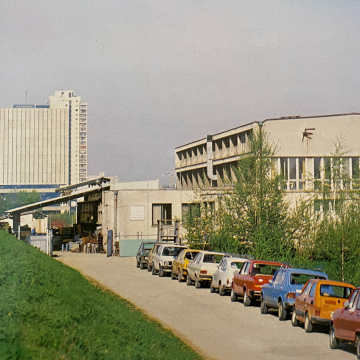
The sole mention of this “unfinished water reservoir and machine room structure” is found in the documentation for the building’s conversion into the Institute of Process Engineering in 1965, which was done according to the design by the architect Božidar Kolonić and finished in late 1966. The Institute was established as a research and production facility for professional engineering, design and commissioning of various types of equipment for manufacturing processes by a large industrial consortium comprising the Zagreb-based factory Jedinstvo, the Steam Boiler Factory, the Institute of Automatization and Oil, the Slavonski Brod based factory Đuro Đaković, and the Swedish factory Alfa-Laval.

Its founding was prompted by the need to further advance the performance of the chemical, food-processing, metallurgic, leather, textile, rubber, pulp and other branches of industry in order to match or even exceed international production standards, as well as to establish preconditions for competitive exports. The variety of products and technologies developed at the Institute included, among other things, centrifugal evaporators, mono-pumps with patented rotors, plate heat exchangers, the development of hyper-concentrated tomato paste, and the technology to make and package ready-to-eat salads.

Considering there were no PhD holders among the ten to fifteen strong workforce, the Institute was at some point renamed the Industry for Process Engineering, and later reportedly even operating as the Center for Research and Development. Since the Jedinstvo factory accounted for around 70-80% of its production output, the Institute was incorporated into the factory after the enactment of the Law on Associated Labor in 1977, or more precisely, it became part of SOUR Jedinstvo (with SOUR translating to Complex Organization of Associated Labor) – a manufacturer of process equipment for the food and chemical industries – and became OOUR Pump Production (with OUOUR translating to Basic Organization of Associated Labor). The state-owned enterprise Jedinstvo was founded in 1947 after the nationalization of the artisan workshop of Miloš Zagorac, while simultaneously to its founding construction started on its industrial complex in Jankomir, along with a workers’ settlement in Gajnice. Since the youth brigades aided in its construction, the factory was officially called the Youth Factory Jedinstvo until the 1960s, and is even to this day colloquially referred to as the “factory for factories”.

The extent and exact manner of use of the Trnje-based building after its assimilation with Jedinstvo remains unclear; it may have operated as a distinct production facility, even though the available sources offer scant documentation on this, other than noting that it produced a wide range of volumetric and kinetic pumps and pump aggregates which were used to supply the production lines and other equipment within Jedinstvo’s manufacturing operation. It is entirely possible it was solely used as a storage space, and several former workers state that the entire Trnje facility was moved to Jankomir, which left the building completely empty and forgotten.
The workforce of Jedinstvo grew from a starting 90 to as many as 2500 by the 1980s, but after the collapse of the USSR, one of its biggest customers, and its subsequent privatization and transformation into a joint-stock company, Jedinstvo met the same fate as almost any other factory in Zagreb – bankruptcy. In 2005, the company Jedinstvo – Novo Ltd. was launched in what remained of the old production facility, focusing on the manufacturing of machines for the food, drinks and tobacco industries, and it continues to operate with a staff of about a dozen workers.
When cultural and artistic collectives moved in the during the late 1990s, some machines were indeed found in the main hall, but their exact purpose or ownership remain unknown. Attempts to glean the information were not helped by the fact that documents regarding the history of urban planning of Trnje contained no explanations about the construction of the original complex or the subsequent establishment of the Institute, considering that Trnje as a whole remained unrecognized by official urban development plans in the early decades of the twentieth century.

How a Factory for Factories Became a hub for culture
The preservation of the small complex was possible because of the 1965 building permit issued by the Secretariat of Construction and Municipal Affairs of the Zagreb City Assembly in order to adapt the water reservoir and machine room structure into the Institute of Process Engineering, which was unusual considering the very ambitious proposals in the Preliminary Urban Planning Proposal for Trnje in that period. The original design of the Institute included a large prefabricated hall with an engineering facility as its central element, which today serves as the Big Hall of Pogon and is often described as the most beautiful black box there is.
The western side of the building housed the design office, now part of the Indoš Parainstitute, while the eastern side contained the buffet, toilet facilities and the manager’s office with administrative services. The present-day Small Hall of Pogon, located on the first floor, originally contained a process laboratory or technical department, where plans and other documents were prepared. While large windows set in the eastern wall, almost as high as the wall itself, faced the exterior, the now sealed western wall was also glazed, enabling a view of the main hall.
The southern section of the building, now the premises of the club Močvara, may have originally contained a chemical lab, administrative offices, and/or a library. The foundations of Pogon’s building, a deep basement space, are a peculiar story since they would flood every time the river level rose. To prevent the entire factory from flooding, the workers installed pumps in pre-drilled holes to help drain the water – not an overly effective system, considering the all too recent flooding of Pogon in 2019.
In its early years, access to the Institute was provided by two footbridges crossing the now-covered Kuniščak stream via an unpaved road branching off the street IV Prudi. The paved parking area and the street Trnjanski nasip, which replaced the street Ribarski put, came years later. After the Institute was converted into a production facility for the Jedinstvo factory, not all of the aforementioned spaces retained their original purpose, but the details of their new functions remain unknown.


After the relocation of the Croatian Ministry of Defense into all the facilities of Jedinstvo in 1995, with the exception of Jedinstvo – Novo, part of its landholdings, properties and equipment were transferred to the state, while parts were sold off or assigned to creditors. In 1997, the City of Zagreb bought the former Institute for Process Engineering, or more specifically, the factory facility in Trnje, and subsequently entrusted its management to the City Office for Culture.
Ambitious plans were enthusiastically presented in 1998 and they envisioned a modern adaptation of certain halls for music, theater and dance performances, a basement disco, office spaces for each resident collective, and a restaurant that would ensure the financial viability of the whole project, but ultimately the large main hall, the smaller hall on the first floor of Pogon, as well as the southern hall housing Močvara, have remained operational largely due to the efforts of various groups inhabiting the space throughout the years. These include: the Kufer Theatre Company, the Indoš Parainstitute by Damir Bartol Indoš, URK – The Office for Culture and the club Močvara, Attack!, and the Temporary Illegal Center for Independent Culture and Youth created by the Alliance for a Center for Independent Culture and Youth.

After decades of bureaucratic and political negotiation with city governments, intermittent closures, numerous actions and even spatial interventions, an agreement was finally reached in 2008, whereby the City of Zagreb and the Alliance for a Center for Independent Culture and Youth, nowadays Operation City, were named co-founders of the Zagreb Center for Independent Culture and Youth – the sole example of such a hybrid civil-public partnership in Croatia. Consequently, the club Močvara, under the direction of URK, now operates in the southern hall of Pogon, the former tool shop is the workspace of the House of Extreme Musical Theatre of DB Indoš, and the large and small halls are run by Pogon – Zagreb Center for Independent Culture and Youth.

Due to its original industrial purpose, the building has both advantages and disadvantages. The size, interior height and technical parameters of the large hall – along with its adaptability to various production demands, as well as its own power substation – allow for the realization of technically complex programs, while the brightness and intimacy of the smaller hall offer optimum conditions for activities like rehearsals and workshops.
On the other hand, those same industrial characteristics – together with the consequences of years of abandonment, dampness, repeated flooding caused by the proximity of the river, and the impossibility of significantly upgrading the space without a comprehensive reconstruction –prevent Pogon from being transformed into a fully adapted multifunctional cultural centre. That said, the combination of the diversity of its interior spaces, the size of its outdoor courtyard, the proximity of the embankment and the river, and its operating principle as a platform open to all ideas from the field of contemporary art and other social activities nevertheless manages to meet a wide range of the spatial needs of culture and the programmatic needs of youth.

The Past – The Present – The Future?
According to the latest General Urban Plan for the City of Zagreb from 2025, the site of Pogon Jedinstvo is designated a mixed-use area. Accordingly, it allows for cultural activities, public and community projects and creative and service-based activities, as well as the commercial use of certain areas, while it prohibits heavy industry, clean production and large-scale logistics and storage functions. Pogon Jedinstvo is fully compatible with this designation, especially since cultural and social functions are in fact encouraged in the Trnje area. The southern side of the Pogon site borders the protected riverbank of the Sava where construction is strictly forbidden; only infrastructural and landscape interventions are allowed, and the area is further regulated with strict and specific provisions. These restrictions do not negate Pogon’s function, they simply limit its potential expansion toward the river, emphasizing the public and open character of the riverbank area. Although the mixed-use area in Trnje is covered by the Urban Development Plan “The Sava Stretch – South of Prisavlje Street” currently in preparation, the new General Urban Plan finally allows for a renovation of the building, as well as a certain degree of expansion within a defined maximum floor area, which was not possible according to previous amendments to the General Urban Plan.

Despite years of waiting and other hardships, the Pogon site still performs its century-long community role. What once served as an informal – and occasionally formal – bathing site for the inhabitants of Trnje and their animals, later became the Institute of Process Engineering and then the production facility of the Jedinstvo factory, which not only represented a workplace and a source of livelihood, but a community or even a second home: “It was precisely the connection of the people and JEDINSTVO, the unity of the collective, that greatly contributed to the factory’s manufacturing reputation and its overall rate of success. (…) New socioeconomic relations appeared and developed along with the factory, a self-management ethic and a new quality of interpersonal relations in the decision-making process connected to the production, distribution and consumption of newly created value” (Čolaković, 1986).
Pogon Jedinstvo also represents the continuation of the sociocultural history of Trnje as a whole, where all throughout the twentieth century art and culture were produced in cinemas, theaters, local council buildings, culture and art associations, educational organizations and so on.

Everything that Pogon’s architecture and operational model achieve today is aptly described by Hrvoje Spudić, a member of the film laboratory Klubvizija, whose program Klubvizija: An Open Lab took place in Pogon in 2023: “We decided to hold the program in Pogon precisely because of the architectural specifics of the space. Our main goal was to create “the largest darkroom in the world”, which the Big Hall of Pogon essentially already is. (…) The technical peculiarities (the inside plumbing needed for the lab, analog and digital film projections etc.) were embraced as a challenge by the technical team, and I believe that any other venue in Zagreb would have rejected the program on those grounds alone. The program we organized in Pogon attracted a wider audience than originally expected, which helped us broaden the scope of our activities and find new associates for new programs we are currently working on” (Dmitrović Krištofić, 2024).